

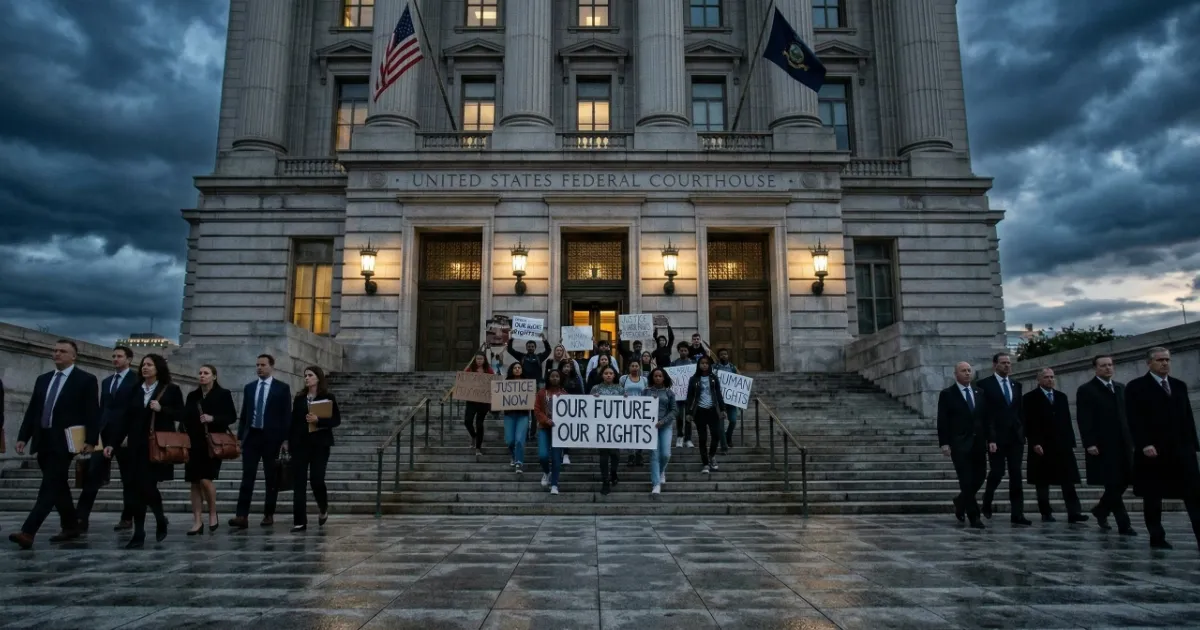
Three Fronts, One Fight: The Full Legal Map of the Endangerment Finding Battle
Key Takeaways
- Three separate lawsuits are now active in the D.C. Circuit challenging the EPA’s repeal of the 2009 Endangerment Finding
- Front 1: A 17-organization coalition including NRDC, EDF, Earthjustice, and the Sierra Club filed February 18 — a statutory challenge under the Clean Air Act
- Front 2: Venner v. EPA — 18 youth plaintiffs from 10 states assert violations of the Fifth Amendment right to life and liberty, the First Amendment right to free exercise of religion, and the separation of powers doctrine
- Front 3: A coalition of 24 state attorneys general plus over a dozen cities and counties filed March 18–19, completing the 60-day state filing window
- The EPA quietly abandoned its science argument — its 436-page final rule rests entirely on statutory interpretation, not any claim that climate science has changed
- April 20 is the effective date — and the hard deadline for any remaining state filings
- A parallel immunity push is advancing in Congress and at least 5 state legislatures, designed to shut down the exact lawsuits keeping this fight alive
The clock is running.
On April 20, 2026 — less than four weeks from now — the EPA’s repeal of the 2009 Endangerment Finding officially takes effect.
When that happens, the legal foundation for all federal greenhouse gas emission standards disappears. Vehicle emissions, power plant limits, methane regulations — every protection built on the Endangerment Finding unravels from a single date forward, unless the courts intervene.
Three separate lawsuits are now active in the U.S. Court of Appeals for the D.C. Circuit.
They don’t overlap. They don’t duplicate each other. They attack the repeal from three distinct legal angles — and together, they form the most comprehensive legal challenge to a single deregulatory act in U.S. environmental history.
Here is the full map.
Front 1: The Statutory Case
The first lawsuit landed on February 18 — the same day the repeal entered the Federal Register.
A coalition of 17 health and environmental organizations filed in the D.C. Circuit, led by the Natural Resources Defense Council (NRDC), Environmental Defense Fund (EDF), Earthjustice, the Sierra Club, the American Public Health Association, and the Center for Biological Diversity, among others.
Their argument is grounded in the plain text of the Clean Air Act.
The law requires the EPA to regulate air pollutants that “may reasonably be anticipated to endanger public health or welfare.” By rescinding the Endangerment Finding — the determination that greenhouse gases meet that standard — the coalition argues the EPA has illegally reversed its core statutory mandate.
“EPA flips its mission on its head,” said Hana Vizcarra, senior attorney at Earthjustice. “It abandons its core mandate to protect human health and the environment to boost polluting industries and attempts to rewrite the law in order to do so.”
Peter Zalzal of the Environmental Defense Fund put it in terms of lives: “Repealing the Endangerment Finding endangers all of us. People everywhere will face more pollution, higher costs, and thousands of avoidable deaths.”
The coalition’s central legal argument is that the EPA is “rehashing legal arguments that the Supreme Court already considered and rejected” in Massachusetts v. EPA — the 2007 precedent that mandated the original Endangerment Finding.
That precedent still stands.
Front 2: The Constitutional Case
The second lawsuit is different in kind — and its legal theory could reshape the entire battleground.
On February 17–18, Our Children’s Trust and Public Justice filed Venner v. EPA on behalf of 18 young plaintiffs from Alaska, California, Colorado, Hawai’i, Montana, New York, Pennsylvania, Tennessee, Washington, and Wisconsin — including students, Tribal and Native youth, and youth from rural and coastal communities.
These 18 young people are not arguing only that the EPA violated the Clean Air Act.
They are arguing that the repeal is unconstitutional.
Their three core constitutional claims:
- Fifth Amendment — Right to Life: Rescinding the Endangerment Finding increases greenhouse gas pollution that directly harms the health, safety, and longevity of the youth petitioners — including increased vulnerability to heat stress, respiratory injury, and long-term damage to quality of life.
- Fifth Amendment — Right to Liberty: Liberty includes bodily integrity, the ability to form families, engage in cultural practices, and pursue happiness. Escalating climate harm endangers all of it.
- First Amendment — Free Exercise of Religion: Several petitioners’ Indigenous spiritual practices and faith traditions depend on a livable environment. The repeal actively burdens those practices — especially from an agency whose administrator has publicly mocked climate science as a “religion.”
Venner v. EPA also adds a separation of powers argument that deserves particular attention: the EPA cannot unilaterally rescind a statutory determination required by Congress simply because it prefers a different policy. Congress writes the laws. Agencies implement them. An agency cannot rewrite or ignore what Congress mandated — even under the “major questions” doctrine the Trump administration is invoking as cover.
“Every ton of greenhouse gas pollution is a threat to these children’s lives. Every. Single. Ton,” said Julia Olson, Chief Legal Counsel for Our Children’s Trust. “They’re fighting for their lives and their health and their safety against the most powerful government on the planet.”
The youth petitioners are currently awaiting the EPA’s response in the D.C. Circuit.
Front 3: The State Coalition
The third front — the one we predicted in our previous coverage — arrived March 18–19.
A coalition of 24 state attorneys general, joined by over a dozen cities and counties, filed suit in the D.C. Circuit, completing the 60-day state filing window ahead of April 20.
The coalition is led by New York AG Letitia James alongside California’s Rob Bonta, Massachusetts’ Andrea Joy Campbell, and Connecticut’s AG William Tong.
“The Trump administration has opted for denial, dismantling essential protections that are vital to the federal government’s approach to climate change,” said AG James.
Massachusetts AG Campbell invoked the state’s historic role directly: “Two decades ago, the Massachusetts Attorney General’s office led the fight to force the federal government to protect the American people from the proven dangers of greenhouse gas emissions, and we will lead once again.”
California AG Bonta: “Climate change is not a distant threat; it is already harming Californians through increased wildfires, rising sea levels, and extreme heat. California will challenge this illegal action in court.”
States have their own standing arguments in this litigation. They represent populations experiencing measurable, ongoing harm from unregulated emissions — and they have existing regulatory frameworks that the federal rollback directly disrupts.
With all three cases now active in the same court, the D.C. Circuit docket is the most consequential climate battleground in the country right now.
The EPA’s Exposed Position
Here’s what makes all three challenges formidable: the EPA cannot argue the science changed.
As we reported in our earlier coverage, the EPA’s final 436-page repeal rule abandoned any scientific refutation entirely. After its DOE Climate Working Group was ruled illegally formed — having violated federal public records laws — the agency pivoted to pure statutory interpretation: arguing that Congress never authorized greenhouse gas regulation under the Clean Air Act.
That argument collides directly with Massachusetts v. EPA (2007), which the Supreme Court decided explicitly on that question.
It also runs headlong into the National Academies of Sciences, which stated explicitly that the Endangerment Finding “was accurate, has stood the test of time, and is now reinforced by even stronger evidence.”
The EPA must win entirely on legal interpretation — in front of the same D.C. Circuit that unanimously upheld the Endangerment Finding in 2012, ruling it was “supported by substantial evidence” and conducted “in a rational manner.”
That is a steep hill for an argument the agency itself couldn’t fully commit to in writing.

In Science We Trust T-Shirt
The science doesn't change because a rule says so. Neither should we.
Wear This Message
April 20 and the Counter-Offensive
April 20 is not just the effective date of the repeal. It is also the close of the state filing window — the last day additional states or municipalities can file in the D.C. Circuit as of right.
Beyond that date, litigation will proceed on a timeline legal analysts expect to stretch years — almost certainly reaching the Supreme Court, where a 6-3 conservative majority makes the ultimate outcome genuinely uncertain.
That timeline has a brutal implication: even a legal victory could take three to five years, during which emissions go unregulated and the damage compounds.
There is also a parallel counter-offensive designed to make these lawsuits irrelevant before they ever reach a verdict.
As we covered in Preempt Everything, Rep. Harriet Hageman’s federal fossil fuel immunity bill remains in active drafting with no formal introduction yet. But at the state level, immunity shield bills have already cleared the Oklahoma Senate, are on the verge of being signed in Utah (with a May 6 effective date), and are advancing in Iowa, Louisiana, and Tennessee — all states facing significant climate vulnerability.
These bills don’t dispute the science either. They simply propose to make the lawsuits themselves illegal.
Why Three Fronts Matter
Fighting on three legal fronts simultaneously is not redundancy. It is strategy.
The statutory case gives the D.C. Circuit a narrow, clean path: the EPA violated the Clean Air Act’s plain text. The constitutional case gives the courts a broader mandate: even if Congress’s intent were ambiguous, the Constitution protects children’s fundamental rights to life and liberty. The state coalition adds democratic standing and weight from the populations most directly harmed by the rollback.
If one argument is narrowed or denied, another may carry. If all three proceed simultaneously, the EPA faces legal exposure on statutory, constitutional, and state-standing grounds at once.
“The Endangerment Finding has been the backbone of climate policy for 17 years,” said Lawrence Hafetz, Legal Director of the Clean Air Council. “Deadly floods, droughts, wildfires, and hurricanes are harming our health, our communities, and our economy. This climate chaos plan is decimating the EPA’s ability to act when we need protections more than ever.”
The administration can rescind a legal finding. It cannot rescind the physics.
And the courts — where evidence still has standing — are now the last institution positioned to force that reckoning.
We will be covering every development as April 20 approaches.
Subscribe via RSS
Copy this URL and add it to your favorite RSS reader:
Popular RSS readers:
- • Feedly
- • Inoreader
- • NewsBlur
- • The Old Reader