The First Warning
The American Petroleum Institute commissions a Stanford Research Institute report that warns: 'Significant temperature changes are almost certain to occur by the year 2000.' The report is not made public.


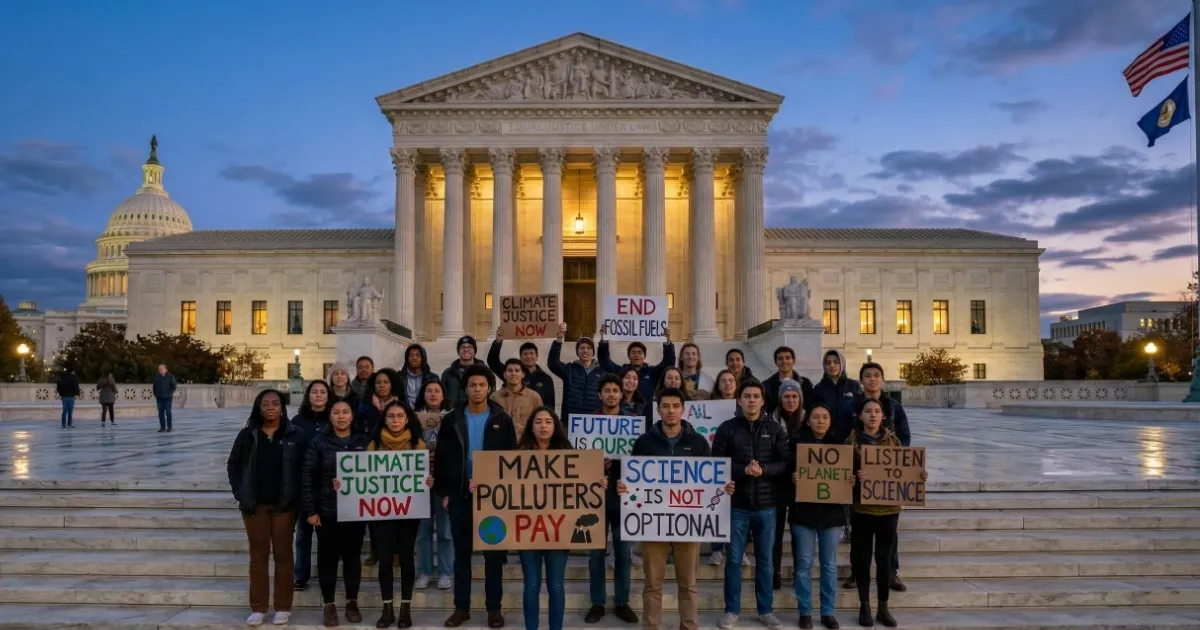
In our first post, we covered the Trump administration’s repeal of the EPA’s 2009 Endangerment Finding — the scientific determination that greenhouse gases endanger public health. In our second, we covered the legal firewall that activated within hours: two separate D.C. Circuit lawsuits from a 17-group coalition and 18 young constitutional plaintiffs.
This is the third front — and in some ways, the most consequential one. It does not involve the EPA at all. It involves a Colorado city, two oil giants, and a question the fossil fuel industry has spent seven decades and billions of dollars trying to prevent anyone from asking in court, under oath, with compelled document production:
What did you know? When did you know it? And what did you do about it?
On February 23, 2026, the U.S. Supreme Court agreed to hear Suncor Energy Inc. v. Commissioners of Boulder County — granting the fossil fuel industry’s petition to review a May 2025 Colorado Supreme Court ruling that allowed Boulder’s climate damages lawsuit to proceed in state court. ExxonMobil and Suncor’s core argument is federal preemption: greenhouse gas emissions are a national and international issue, and the federal Clean Air Act therefore bars state courts from adjudicating climate liability claims.
There is a problem with this argument that deserves far more attention than it has received: it is being made by the same federal administration that just argued the opposite.
When the Trump EPA rescinded the Endangerment Finding on February 12, its final 436-page rule rested on the explicit claim that Congress never authorized the EPA to regulate greenhouse gases under the Clean Air Act. That is the administration’s statutory argument for eliminating all federal emissions standards. But in the Supreme Court case, the administration is backing ExxonMobil and Suncor in arguing that the same Clean Air Act does occupy the field so comprehensively that it prevents states from acting in its place.
The logic cannot hold in both directions at once. The federal government cannot be simultaneously stripped of authority by the Clean Air Act and protected by it. As the Columbia Climate Law Blog noted, Boulder’s own legal brief flagged that the EPA’s Endangerment Finding repeal “could significantly affect the preemption arguments” in this very case — because an agency that has just declared it has no authority to regulate a pollutant has a weaker claim that it has “occupied the field” of that pollutant’s regulation.
This is not a minor legal technicality. It is the central hypocrisy of the current administration’s climate strategy, compressed into a single sentence: strip the federal government of the power to regulate pollution, and strip local communities of the right to sue the polluters. The goal is a regulatory vacuum in which no one — not Washington, not Boulder, not 18-year-olds in federal court — can hold fossil fuel companies accountable for anything.
To understand why ExxonMobil and Suncor are fighting so hard to keep this case out of court, you have to understand what a trial would actually look like — and what it would require them to produce.
Boulder’s lawsuit is not primarily about emissions. It is about deception. The city and county are arguing that fossil fuel companies spent decades funding a sophisticated disinformation campaign to obscure climate risks that their own internal research had already confirmed. The legal theory is grounded in consumer fraud, public nuisance, and negligent misrepresentation — and it requires evidence. Internal evidence. The kind that only surfaces through discovery.
Here is what we already know from investigative journalism — and what compelled testimony and document production could deepen dramatically.
A documented timeline of internal industry knowledge versus public messaging
The American Petroleum Institute commissions a Stanford Research Institute report that warns: 'Significant temperature changes are almost certain to occur by the year 2000.' The report is not made public.
Senior Exxon scientist James Black briefs company executives on the greenhouse effect, warning that doubling CO2 in the atmosphere could raise global temperatures by 2–3°C. He cautions that this could require 'major reductions in fossil fuel combustion.'
Exxon launches a serious in-house research program — outfitting a supertanker with CO2 monitoring equipment and building climate models. Internal memos from this period show scientists warning that, without action, warming 'will indeed be catastrophic.' A 2023 Harvard-led study later finds these projections matched observed reality with 'shocking skill and accuracy.'
Royal Dutch Shell produces an internal report marked CONFIDENTIAL titled 'The Greenhouse Effect.' It warns of sea level rise of up to one meter, forced migration, abandonment of entire nations, 'the disappearance of specific ecosystems,' and 'the impacts on the world's food supply.' The report is not published. Shell continues to publicly fund climate doubt for decades.
NASA scientist Dr. James Hansen testifies before the U.S. Senate that global warming 'is already happening now.' This is the moment the public becomes broadly aware of climate change — a decade after Exxon's own executives had been privately briefed on the same science.
The fossil fuel industry forms the Global Climate Coalition, a lobbying group dedicated to opposing emissions regulation and casting doubt on climate science. Members include ExxonMobil, Shell, BP, and the American Petroleum Institute. The Coalition operates until 2002.
An internal American Petroleum Institute memo — later leaked — outlines a campaign to recruit and train 'independent scientists' to challenge the IPCC consensus. It states: 'Victory will be achieved when average citizens 'understand' (recognize) uncertainties in climate science. The memo explicitly targets science education and the media.
InsideClimate News and the Columbia University Graduate School of Journalism publish investigations revealing Exxon's internal climate research. The reports confirm that Exxon's own scientists had accurately predicted global warming for decades while the company publicly funded doubt. The hashtag #ExxonKnew enters the national conversation.
The City of Boulder and Boulder County, Colorado file a climate liability lawsuit against ExxonMobil, Suncor Energy, and other fossil fuel companies, seeking damages for the local costs of climate-driven extreme heat, drought, and wildfire. The case is grounded in the companies' documented decades of deception.
The Colorado Supreme Court rules that Boulder's lawsuit can proceed in state court, rejecting the fossil fuel companies' first attempt at removal to federal court. ExxonMobil and Suncor immediately petition the U.S. Supreme Court.
The EPA rescinds the 2009 Endangerment Finding. On the same day, Rep. Harriet Hageman (R-WY) announces legislation to grant fossil fuel companies complete immunity from all climate liability lawsuits. The coordination is not coincidental.
The U.S. Supreme Court agrees to hear *Suncor Energy Inc. v. Commissioners of Boulder County*. Crucially, the Court also asks both parties to brief whether it even has jurisdiction at this pre-trial stage — a threshold question that could result in the case being sent back to trial without ever reaching the preemption argument.
Most accounts of corporate science denial trace the strategy back to Big Tobacco’s mid-20th-century campaign to manufacture doubt about the link between cigarettes and cancer. But research from the Center for International Environmental Law reveals that the playbook did not originate with tobacco. The oil industry built the denial apparatus first — around the hazards of leaded gasoline and industrial smog — and Big Tobacco adapted and refined it.
The same infrastructure of front groups, laundered research funding, and manufactured public uncertainty that Dr. Michael Mann described in our first post as a “chatbot trained on fossil fuel-funded denier websites” was not improvised. It was a deliberate, decades-long engineering project. As UCS research notes, Big Tobacco’s own deception story ended “with industry executives held accountable in our country’s highest courts for their lies.” That is the precedent the Boulder lawsuit is chasing.
The direct line runs from that 1954 Stanford Research Institute report, buried by the API, all the way to Administrator Lee Zeldin standing at the White House on February 12 and dismissing climate science as a “religion.” When Zeldin uses that word — a word designed to reframe scientific consensus as irrational belief — he is reciting lines written by the same corporations now asking the Supreme Court to protect them from accountability. The rhetoric did not emerge spontaneously from political culture. It was manufactured, distributed, and paid for.
The Boulder case does not stand alone. It is one node in a coordinated, multi-front strategy to render climate accountability structurally impossible.
The American Petroleum Institute declared eliminating state climate lawsuits one of its top legislative priorities for 2026. On February 12, 2026 — the exact same day the EPA rescinded the Endangerment Finding — Rep. Harriet Hageman (R-WY) announced legislation that would grant the fossil fuel industry sweeping immunity from all climate liability lawsuits in state and federal courts. As the Center for Climate Integrity documented, the bill is intended to function as a legislative failsafe: if the Supreme Court does not deliver a favorable ruling, Congress would simply make the lawsuits illegal.
Read that structure carefully. The judicial front (Supreme Court preemption argument) and the legislative front (Hageman immunity bill) are running in parallel, with a shared purpose. A Supreme Court ruling in Big Oil’s favor would provide legal momentum and precedent for the immunity bill. A ruling against them would accelerate the bill’s urgency. Either way, the industry has a path to the same destination: a world in which no court, state or federal, can hear a climate accountability claim.
This is not litigation strategy. It is a legislative endgame. And it is happening right now, in parallel with everything we covered in our D.C. Circuit post.
If the Hageman bill passes, it would also threaten Climate Superfund laws already enacted in Vermont and New York — state laws designed to require oil majors to contribute to climate disaster recovery funds proportional to their historical emissions. These laws have already drawn industry legal challenges; federal immunity legislation would gut them entirely.
There is a question about the Supreme Court itself that most coverage of this case has been reluctant to ask directly: Should Justice Samuel Alito be sitting on this case at all?
In January 2026, Alito’s recusal in a separate oil investment case renewed scrutiny of his financial holdings. DeSmog reported that Alito recused himself from a 2023 petition in the Boulder case and from the 2025 Honolulu climate lawsuit petition — but has not recused himself from the current, granted certiorari in the same Boulder case. He owns stock in oil companies facing the same category of climate liability lawsuits that Suncor v. Boulder could foreclose.
As Jacobin reported in November 2025, the justice has a direct financial stake in outcomes that a ruling for Big Oil would produce: if state climate liability cases are preempted, the value of fossil fuel stocks is materially affected. The question of whether Alito’s participation in this ruling is appropriate is not a partisan attack. It is a democratic accountability question — and given that we have argued in this series that the courts are now the climate frontline, the integrity of those courts is not a footnote. It is the story.
Here is the part of this story that almost no one is reporting — and it may ultimately matter more than all the substantive legal arguments.
When the Supreme Court granted certiorari on February 23, it did something unusual: it also asked both parties to brief the threshold question of whether it even has jurisdiction to hear the appeal at this pre-trial stage. The Colorado Supreme Court’s ruling was not a final judgment — it was an interlocutory ruling on removal jurisdiction, meaning the case had not yet gone to trial. The Supreme Court typically only reviews final judgments.
Boulder has argued that reviewing this ruling now would produce exactly the kind of “piecemeal appellate review” courts are supposed to avoid — and that even if the Court found some grounds for preemption, Boulder’s state-law claims about in-state deception might survive anyway as a separate matter.
If the Supreme Court decides it should not have taken the case at this stage, it dismisses the petition and sends the case back to state court for trial. That outcome — without ever touching the preemption question — would be a de facto win for Boulder, and it would leave the 30+ similar climate liability lawsuits nationwide entirely intact. Watch the jurisdictional briefing schedule. It may render the preemption debate moot before oral arguments even begin.
Here is the question that reframes everything else: why is ExxonMobil — one of the largest and most legally resourced corporations in human history — fighting this hard to prevent a Colorado case from going to trial?
The answer is discovery.
Under U.S. civil procedure, a case that proceeds to trial requires both parties to produce internal documents, communications, and records. ExxonMobil and Suncor would be compelled to provide, under penalty of perjury, the full archive of what they knew, when they knew it, and what they chose to do about it. The 2015 journalistic investigations that gave us #ExxonKnew were built on documents that leaked or were obtained through public records requests. A trial discovery process would go orders of magnitude deeper.
The Harvard-led study published in Science in 2023 found that ExxonMobil’s own scientists had produced global warming projections of “shocking skill and accuracy” — models that closely tracked observed reality — while the company was publicly funding doubt about that same science. That is what peer-reviewed analysis of already-public documents showed. What remains locked in Exxon’s internal archives is a question a discovery subpoena could answer.
This is not primarily about the dollars Boulder is seeking in damages. It is about forcing the largest corporate deception campaign in modern American history into the public record, under oath. That is what the Hageman immunity bill is designed to prevent. That is what federal preemption would foreclose. And that is why, regardless of what the Supreme Court ultimately decides, the fight to get this case to trial is itself a form of climate accountability.
As Peter Zalzal of the Environmental Defense Fund stated when the D.C. Circuit coalition filed its brief: “Repealing the Endangerment Finding endangers all of us.” The same logic applies here. Preempting every state lawsuit doesn’t just protect ExxonMobil from a damages award. It ensures that what was in the archives in 1954 — and in 1977, and in 1986 — stays there.

The legal road ahead is long, but the immediate calendar is specific. Briefing on the threshold jurisdictional question will proceed through the spring of 2026. If the Court retains jurisdiction, merits briefing will follow over the summer, with oral arguments expected in fall 2026. A decision from the Supreme Court would likely come in spring 2027.
Meanwhile, the Hageman immunity bill will move through committee under API pressure. Climate Superfund laws in Vermont and New York face their own legal challenges, now newly emboldened. State AGs who pledged to fight the Endangerment Finding repeal — California’s Rob Bonta, Massachusetts’ Andrea Joy Campbell, Arizona’s Kris Mayes — are watching this docket as closely as the D.C. Circuit one.
These are not separate battles. They are the same battle, conducted simultaneously on every available front, by a coordinated set of actors who have been at this for 70 years. The only thing that has changed is that the stakes are now existential and the timeline is closing.
The courts may still hold. Discovery may still happen. The jurisdictional wild card may send this case back to trial. The 18 young plaintiffs in the D.C. Circuit are still fighting. The 17-group coalition is still litigating the Endangerment Finding rescission. And the physics — whatever any court, any administration, or any oil company memo says — is still operating exactly as Exxon’s own scientists predicted it would, back when they were still telling the truth internally.
We will be covering every development.
Copy this URL and add it to your favorite RSS reader:
Popular RSS readers: