

The Courts Strike Back: Inside the Legal War to Restore Climate Protection
Key Takeaways
- Two separate lawsuits filed February 17–18 in the D.C. Circuit — hours after the repeal hit the Federal Register
- A coalition of 17 health and environmental organizations — including NRDC, EDF, Earthjustice, Sierra Club, and the American Public Health Association — filed the primary challenge
- Our Children’s Trust filed a constitutional suit on behalf of 18 young plaintiffs, arguing the repeal violates their rights to life, liberty, and free exercise of religion
- The EPA quietly dropped its science argument — the final 436-page repeal rule rests entirely on statutory legal interpretation, not a refutation of climate science
- A federal judge ruled the DOE’s Climate Working Group was illegally formed, stripping the repeal of its scientific pretense before the final rule was even issued
- The effective date is April 20, 2026 — states have a 60-day window to file their own challenges; California, Massachusetts, Arizona, and Connecticut have all pledged to sue
- 26 Republican-led state AGs signed a letter backing the EPA; Democratic AGs are preparing an opposing coalition
- Legal resolution could take years, almost certainly reaching a Supreme Court that already ruled greenhouse gases are air pollutants
On February 18, 2026 — the same day the EPA’s repeal of the 2009 Endangerment Finding was officially published in the Federal Register — two separate lawsuits landed in the U.S. Court of Appeals for the District of Columbia Circuit. No waiting. No deliberating. The legal firewall activated immediately.
This is what organized resistance looks like. The legal challenges to the largest deregulatory rollback in U.S. environmental history were not improvised — they were planned and ready to file the moment the final rule hit the public record. The question is no longer whether the courts will weigh in. It’s whether they can move fast enough to matter.
The Coalition Files First
On February 18, a coalition of 17 health and environmental organizations filed a petition for review in the D.C. Circuit. The plaintiffs represent some of the most experienced environmental legal forces in the country:
- Natural Resources Defense Council (NRDC)
- Environmental Defense Fund (EDF)
- Earthjustice
- Sierra Club
- American Public Health Association
- Center for Biological Diversity
- Conservation Law Foundation
- Clean Air Task Force
- Clean Air Council
- Public Citizen
- And seven additional health and environmental partners
The lawsuit names EPA Administrator Lee Zeldin and the EPA itself as defendants. At its core, the coalition argues that by rescinding the Endangerment Finding, the EPA has illegally reversed its Clean Air Act mandate to protect Americans from air pollution that “may reasonably be anticipated to endanger public health or welfare.”
“EPA flips its mission on its head,” said Hana Vizcarra, senior attorney at Earthjustice. “It abandons its core mandate to protect human health and the environment to boost polluting industries and attempts to rewrite the law in order to do so. Earthjustice and our partners will defend what we all know to be true: climate pollution is harming our health, welfare, and economy and EPA has an obligation to control these harmful emissions.”
Peter Zalzal of the Environmental Defense Fund framed the stakes in terms of lives: “Repealing the Endangerment Finding endangers all of us. People everywhere will face more pollution, higher costs, and thousands of avoidable deaths. The Trump EPA’s action tramples mountains of scientific evidence, ignores the law, and is fundamentally at odds with EPA’s core responsibility to protect us from dangerous pollution.”
The coalition’s central legal argument is that the EPA is “rehashing legal arguments that the Supreme Court already considered and rejected in Massachusetts v. EPA” — the same landmark 2007 precedent that mandated the original Endangerment Finding in the first place. Clean Air Council Legal Director Lawrence Hafetz added: “By repealing the finding, we are sweeping the single deadliest type of pollution, climate pollution, under the rug.”
18 Kids, One Constitutional Challenge
The second lawsuit is something fundamentally different — and its legal theory could reshape the entire battleground.
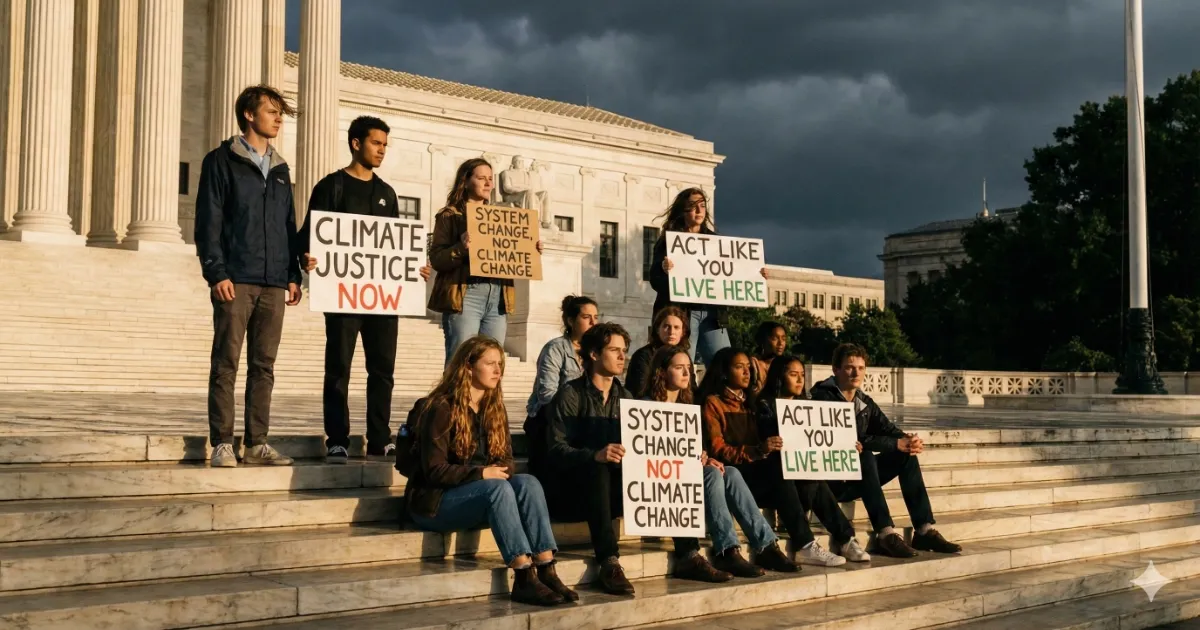
On February 17, Our Children’s Trust and Public Justice filed a petition in the D.C. Circuit on behalf of 18 young plaintiffs. These children and young adults are not arguing merely that the EPA violated the Clean Air Act. They are arguing that the repeal of the Endangerment Finding is unconstitutional — that it violates their rights to:
- Life
- Liberty
- Free exercise of religion
“Every ton of greenhouse gas pollution is a threat to these children’s lives. Every. Single. Ton,” said Julia Olson, Chief Legal Counsel for Our Children’s Trust. “They’re fighting for their lives and their health and their safety against the most powerful government on the planet.”
The constitutional framing is deliberate and powerful. While the coalition lawsuit will fight on statutory grounds — whether the EPA followed its legal mandate under the Clean Air Act — the youth case argues that the federal government has no right to actively unleash pollution that foreseeably endangers the lives of its youngest citizens. The religious freedom component reflects communities whose faith traditions require environmental stewardship, directly confronted by an administrator who has publicly mocked climate science as a “religion.”
As Inside Climate News reported, Olson stated: “By reversing the endangerment finding and standards for cleaner vehicles, EPA is greenlighting dangerous pollution that will fill our communities and lungs with dirty air. That violates children’s constitutional rights to life, liberty, and religious freedom. The court must stop it.”
This case follows in the footsteps of the landmark Juliana v. United States youth climate case, which spent years working through the federal system. Our Children’s Trust has become expert at navigating this terrain — and they are betting that a constitutional framing will outlast any statutory argument the EPA can construct.
The Science Argument the EPA Quietly Dropped
Here is a development that deserves far more attention than it has received: the EPA’s final repeal rule does not argue that climate science is wrong.
In its final 436-page rule published in the Federal Register, the EPA abandoned the scientific basis for its repeal and rested the entire case on statutory interpretation — the argument that Congress never authorized the EPA to regulate greenhouse gases under the Clean Air Act’s Section 202. The agency cited the Supreme Court’s post-2009 decisions, particularly the major questions doctrine established in West Virginia v. EPA (2022), as legal cover.
Why did they drop the science? Because a federal judge had already undermined it. The DOE’s Climate Working Group, which was assembled by the Department of Energy to provide “updated scientific doubt” about the Endangerment Finding’s basis, was ruled to have been illegally formed — having violated federal public records laws in its creation. With that scientific cover stripped away, the EPA had no choice but to pivot to pure legal argument.
“Unlike our predecessors, the Trump EPA is committed to following the law exactly as it is written and as Congress intended — not as others might wish it to be,” the EPA’s press office told Inside Climate News.
Environmental lawyers see this as a critical strategic vulnerability. The EPA cannot argue the science changed, because it knows that argument would be demolished in court by the weight of peer-reviewed evidence. Instead, it must win entirely on statutory interpretation — a much narrower claim, and one that collides head-on with established Supreme Court precedent holding that greenhouse gases are air pollutants.
The National Academies of Sciences stated explicitly that the Endangerment Finding “was accurate, has stood the test of time, and is now reinforced by even stronger evidence.” That statement now hangs over every EPA legal brief like a judgment already rendered.

States Go to War
Federal litigation is not the only front opening up. Multiple state attorneys general have condemned the repeal and pledged their own lawsuits, with a 60-day filing window open until approximately April 20, 2026 — the rule’s effective date.
- California AG Rob Bonta vowed to sue immediately: “Climate change is not a distant threat; it is already harming Californians through increased wildfires, rising sea levels, and extreme heat. California will challenge this illegal action in court, and will continue fighting to defend public health, uphold environmental justice, and protect future generations.”
- Massachusetts AG Andrea Joy Campbell invoked the state’s historic role: “Two decades ago, the Massachusetts Attorney General’s office led the fight to force the federal government to protect the American people from the proven dangers of greenhouse gas emissions, and we will lead once again against the Trump Administration’s attempt to walk away from that responsibility. I’ll see them in Court.”
- Arizona AG Kris Mayes called the action “unlawful, reckless, and flatly at odds with decades of settled law and science.”
- Connecticut AG William Tong and Governor Ned Lamont pledged to fight “for as long as it takes,” adding: “The science and the law are firmly on our side.”
On the other side, 26 Republican-led state attorneys general sent a letter supporting the EPA, claiming the Endangerment Finding “was built on shaky ground — legally and scientifically.” A competing coalition of Democratic-led AGs and seven cities countered with their own letter stating the repeal would exacerbate “the harms that the States and Local Governments are daily experiencing.”
The National League of Cities has also weighed in against the repeal, as mayors across the country face the direct public health consequences of unregulated emissions in their communities.
Correcting the Numbers
In our February 12 coverage of the Endangerment Finding repeal, we reported the Trump administration’s claim of $2,400 in potential vehicle savings. That number demands critical context. Environmental groups are now documenting that the clean car standards being eliminated by this repeal would have saved drivers an average of $6,000 over the lifetime of their vehicles — these were savings, not costs.
The administration eliminated $6,000 in lifetime savings per vehicle, scrapped the single largest planned reduction in U.S. carbon pollution in history, and is offering back a fraction of that figure as the public justification for removing all federal greenhouse gas standards for every vehicle from model year 2012 onward. As the Clean Air Task Force noted, these are not abstract regulatory numbers — they represent decades of public health protection, now eliminated by a single rule.
The Legal Road Ahead
The litigation landscape is complex, and resolution will not come quickly.
The D.C. Circuit Court of Appeals will hear the initial challenges — the same court that unanimously upheld the Endangerment Finding in 2012, ruling it was “supported by substantial evidence.” But the legal terrain has shifted since then. The Supreme Court’s West Virginia v. EPA (2022) established the “major questions doctrine,” requiring clear congressional authorization for major regulatory decisions. The Loper Bright (2024) decision eliminated automatic judicial deference to agency interpretations of law.
The EPA is betting that these two decisions give it the statutory cover to reverse the Endangerment Finding. Environmental lawyers counter that neither case changed the text of the Clean Air Act — which still requires the EPA to regulate pollutants that endanger public health — and that Massachusetts v. EPA established definitively that greenhouse gases are covered pollutants.
From the D.C. Circuit, this case will almost certainly reach the Supreme Court — where a 6-3 conservative supermajority makes the outcome genuinely uncertain. Harvard’s Salata Institute for Climate and Sustainability has assessed that “litigation is expected to proceed through the D.C. Circuit, and likely to the Supreme Court, over the coming years.”
That timeline has a devastating implication: even a legal victory could take three to five years — years during which vehicle emissions go unregulated, methane leaks go unchecked, and power plant emissions remain in a legal gray zone.
Why the Courts Are Now the Climate Frontline
The 18 young people who walked into federal court this week did not choose to be there. They had no other option. When a government decides that physics is optional and that the constitutional rights of children are less important than the quarterly earnings of fossil fuel companies, the courts become the last institution standing between policy and catastrophe.
“The Endangerment Finding has been the backbone of climate policy for 17 years,” said Clean Air Council Legal Director Lawrence Hafetz. “Deadly floods, droughts, wildfires, and hurricanes are harming our health, our communities, and our economy. This climate chaos plan is decimating the EPA’s ability to act when we need protections more than ever.”
The administration can rescind a legal finding. It cannot rescind the physics. It can refuse to count the costs of extreme weather, refuse to acknowledge the scientific consensus documented by the IPCC, and refuse to protect future generations. But it cannot prevent the courts — where evidence still has standing — from examining what was done, whether the law permits it, and whether children have the right to a livable future.
The next battle begins with the April 20 effective date. Watch the D.C. Circuit docket. Watch the state AG filings. Watch the 18 young plaintiffs who chose to fight rather than surrender to despair.
We will be covering every development.
Subscribe via RSS
Copy this URL and add it to your favorite RSS reader:
Popular RSS readers:
- • Feedly
- • Inoreader
- • NewsBlur
- • The Old Reader