

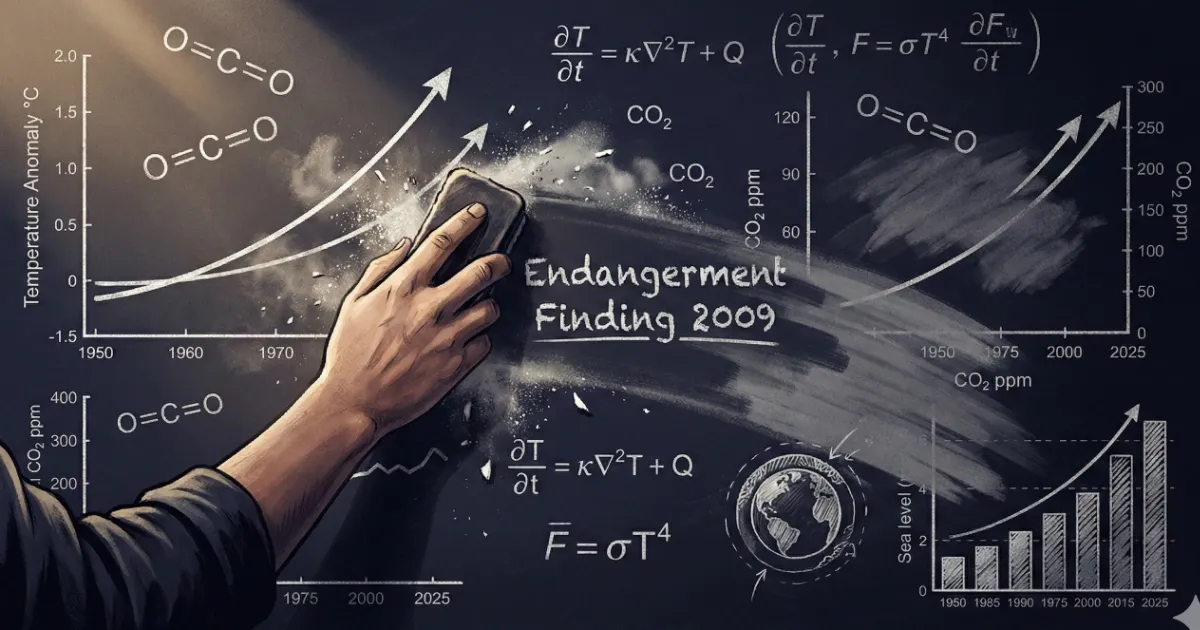
Erasing Reality: The Trump Administration's Attack on the Endangerment Finding
Key Takeaways
- The Trump administration rescinded the 2009 Endangerment Finding on February 12, 2026, eliminating the legal foundation for federal regulation of greenhouse gas emissions
- The Endangerment Finding was a scientific determination, not a political document—mandated by the Supreme Court and supported by thousands of peer-reviewed studies
- Immediate consequences include unregulated vehicle emissions, increased air pollution, worsening respiratory health, and unchecked methane leaks from oil and gas operations
- Climate disasters cost over $120 billion globally in 2025, while the administration promotes potential $2,400 savings on vehicles
- Legal challenges are already underway from NRDC, EDF, and other organizations—the Supreme Court precedent from Massachusetts v. EPA still stands
- States representing 40% of the U.S. economy have pledged to maintain strict climate standards despite federal retreat
- This is an attack on scientific trust itself—framing empirical evidence as “ideology” undermines democracy and expert consensus
On February 12, 2026, EPA Administrator Lee Zeldin officially rescinded the 2009 Endangerment Finding—the scientific determination that greenhouse gases threaten public health and welfare. Standing at the White House alongside President Trump, Zeldin framed this systematic dismantling of climate science as a victory, calling it the end of 16 years of “consumer choice restrictions” and liberation from the “climate change religion.”
This is not hyperbole to call this historic. By erasing the legal foundation that empowered federal agencies to regulate carbon dioxide, methane, and four other greenhouse gases, the administration has severed the connection between observable reality and public policy. This is not about cheaper cars or reducing red tape. This is about whether the United States government will acknowledge the laws of physics.
The Science They’re Trying to Erase
The Endangerment Finding was not a political document. It was a scientific determination mandated by the Supreme Court in the landmark 2007 case Massachusetts v. EPA. The Court ruled that if the best available science showed that greenhouse gases endanger Americans, the EPA was legally required under the Clean Air Act to regulate them.
After reviewing thousands of peer-reviewed studies from institutions including NASA, NOAA, and the Intergovernmental Panel on Climate Change (IPCC), the EPA concluded in 2009 that carbon dioxide and methane drive atmospheric warming, which drives extreme weather events, sea-level rise, and deteriorating air quality—all of which directly harm human health and welfare. The science supporting this conclusion has only grown stronger since 2009. The IPCC’s most recent reports confirm that 3.3 to 3.6 billion people are now vulnerable to climate impacts, and warming will intensify with every fraction of a degree.
Climate scientist Dr. Michael Mann described a similar Trump administration climate report last year as reading like “a chatbot trained on the top 10 fossil fuel industry-funded climate denier websites.” Dr. Katharine Hayhoe, Chief Scientist at The Nature Conservancy, warned earlier in 2025 that “the challenges facing our planet—increasing climate risks, declining ecosystems, and harmful pollution that endangers lives—are no longer future issues. They’re here now, impacting our economy and our health.”
The Court Precedent Still Stands
The administration’s claim that Congress never authorized regulation of greenhouse gases ignores the Supreme Court precedent that has been upheld repeatedly. In 2012, the D.C. Circuit Court of Appeals rejected fossil fuel industry challenges to the Endangerment Finding, ruling that the EPA’s determination was “supported by substantial evidence” and conducted “in a rational manner.” The Supreme Court declined to hear appeals the following year.
The Immediate Dangers We Now Face
The consequences of this decision will cascade across multiple sectors, with devastating effects on public health, economic stability, and environmental integrity.
Unregulated Emissions
Without the Endangerment Finding, the EPA has already abolished all greenhouse gas emission standards for light, medium, and heavy-duty vehicles established since 2009. Limits on power plant emissions are likely next. Methane leaks from oil and gas operations—which trap 80 times more heat than carbon dioxide in the short term—will go unchecked. The transportation sector, which accounts for the largest share of U.S. greenhouse gas emissions (with cars and trucks representing over 75% of that total), will become a regulatory void.
Public Health Crisis
The health impacts will be swift and measurable. Research published in 2025 found that climate change-driven dry air triggers inflammatory and immune responses in human airways, exacerbating asthma, chronic bronchitis, and other respiratory conditions. Medical research confirms that climate change increases ground-level ozone and particulate matter concentrations, worsening respiratory diseases and cardiovascular conditions. Areas with limited healthcare access—including disadvantaged and migrating populations—will suffer disproportionately.
Economic Catastrophe
While the administration touts potential savings of $2,400 on new vehicles (the full picture is more damaging — the standards being eliminated would have saved drivers $6,000 over a vehicle’s lifetime. We correct this figure in our follow-up coverage →), they conveniently ignore the economic devastation already unfolding. According to Christian Aid’s Counting the Cost 2025 report, climate disasters inflicted over $120 billion in damages globally in 2025 alone. The California wildfires cost $60 billion and killed over 400 people. Southeast Asian cyclones and floods caused $25 billion in damages and claimed 1,750 lives. Chinese flooding displaced thousands and cost $11.7 billion. We are trading marginally cheaper SUVs today for uninsurable homes, failed crops, and collapsing infrastructure tomorrow.
The Assault on Trust in Science
Perhaps the most insidious dimension of yesterday’s announcement is the language used to justify it. When Administrator Zeldin dismisses climate science as a “religion” or refers to emissions regulations as “climate participation trophies,” he is not merely disagreeing with scientific conclusions—he is deploying a calculated strategy to erode public trust in the scientific method itself.
Science is not a belief system requiring faith. It is a rigorous, self-correcting process of observation, hypothesis testing, peer review, and replication. The scientific consensus on climate change is not the result of groupthink or ideology—it is the convergence of evidence from atmospheric physics, oceanography, glaciology, ecology, and public health research conducted by thousands of independent scientists across every continent.
“They’re literally trying to tell us not to believe what we see with our own two eyes.” — Dr. Michael Mann, climate scientist
By framing empirical reality as “ideology,” the administration invites Americans to reject expertise and choose their own facts. This is corrosive to democracy. If we cannot agree on the basic behavior of greenhouse gases in the atmosphere—a physical relationship as well-established as gravity—we cannot make informed decisions about our collective future.
This is the ultimate goal of climate denial: to render objective truth subjective, to make scientific expertise a matter of opinion, and to paralyze collective action by sowing confusion and mistrust.

What We Must Do Now
Despair is not a strategy, and defeat is not inevitable. While the federal government has abandoned its duty to protect Americans, multiple pathways remain to defend science-based policy and climate action.
Support the Legal Firewall
Organizations including the Natural Resources Defense Council (NRDC), the Environmental Defense Fund (EDF), and the World Resources Institute have already announced legal challenges to the rescission. NRDC attorney David Doniger stated that it would be “impossible” for the EPA to justify this rule change in court, given the overwhelming evidence that greenhouse gas emissions drive climate disasters. The Massachusetts v. EPA precedent remains in force—the administration will have to prove that the science has somehow reversed since 2009, a burden they cannot possibly meet. Donating to these legal defense funds directly funds the courtroom battles ahead.
Strengthen State-Level Action
Governors Gavin Newsom of California and Tony Evers of Wisconsin, co-chairs of the U.S. Climate Alliance, have already pledged to fight this “unlawful” action that “ignores basic science and denies reality.” States representing over 40% of the U.S. economy can maintain strict emission standards, vehicle efficiency requirements, and renewable energy targets. The federal government can abdicate responsibility, but it cannot prevent states from protecting their residents.
Demand Accountability at Every Level
We must make acceptance of scientific reality a fundamental qualification for every elected position, from school boards to the U.S. Senate. Candidates who deny climate science or who undermine trust in scientific institutions should be disqualified in the eyes of voters. Support educators, science communicators, and journalists who defend evidence-based discourse. Engage with local climate action groups and demand that your representatives commit to science-based policy.
Invest in Trusted Institutions
Support universities conducting climate research, scientific organizations like the American Geophysical Union and the American Meteorological Society, and media outlets committed to accurate science reporting. When public trust in expertise is under attack, we must actively defend the institutions that generate and communicate reliable knowledge.
The Path Forward
Yesterday was a devastating blow to environmental protection and scientific integrity. But it cannot be the final word. The Trump administration can rescind a legal finding, but they cannot rescind the laws of thermodynamics. They can dismiss expert consensus, but they cannot stop the ice from melting or the oceans from rising. Reality does not negotiate, and physics does not compromise.
Our responsibility now is to defend truth, support the legal and scientific institutions under siege, and build the political power necessary to restore science-based governance. This fight will be long and difficult, but it is not optional. The stakes are nothing less than a livable planet and a functioning democracy.
Trust in science is not naïve optimism—it is the foundation of civilization. We must protect it, now more than ever, because the alternative is a world where expertise is irrelevant, evidence is optional, and future generations pay the price for our failure to act.
Subscribe via RSS
Copy this URL and add it to your favorite RSS reader:
Popular RSS readers:
- • Feedly
- • Inoreader
- • NewsBlur
- • The Old Reader