The Compute Paradox: Can Agentic AI Actually Save the Climate?
As a developer, I use AI every single day — for code completion, debugging, architecture decisions, copy drafts. It’s woven into how I work.
And I’m genuinely conflicted about it.
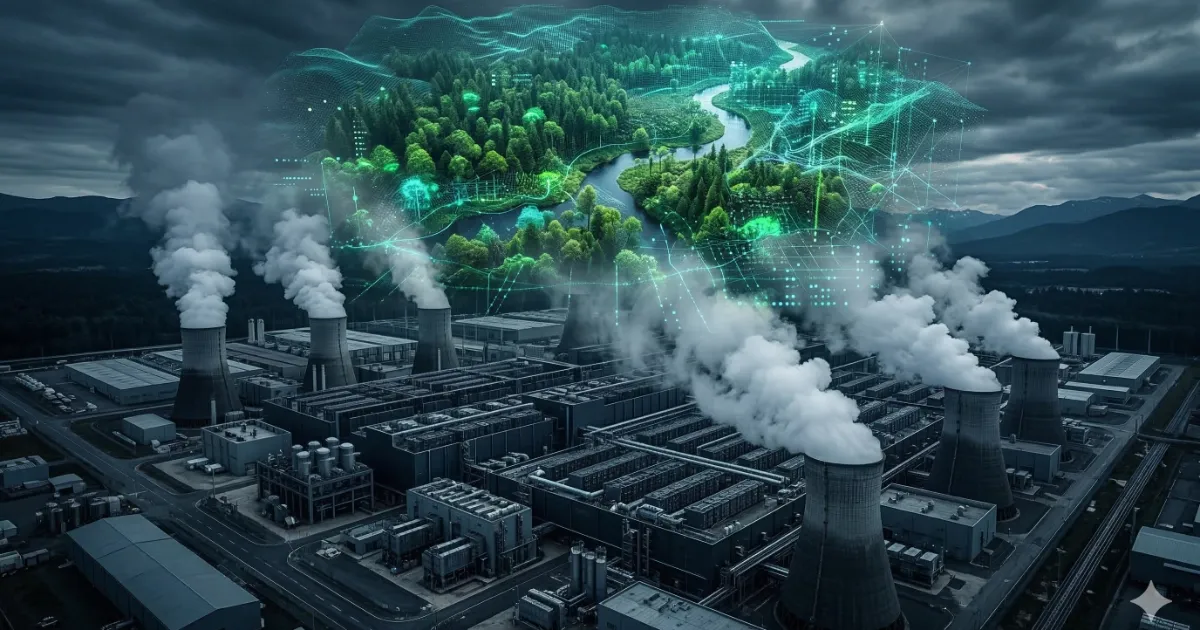
Because I also know what’s happening on the other side of that API call. I know the GPU racks, the cooling towers, the water tables. Every inference request has a physical cost. Every training run has a carbon ledger. That tension doesn’t resolve easily, and I’m not going to pretend it does.
So when Google announced not one but two $30 million “Impact Challenges” in February — AI for Science and AI for Government Innovation — totaling $60M in private funding for mission-driven AI projects, I felt that tension harder than ever.
The promise is real: deploy the most powerful analytical tools in human history to map biodiversity collapse, optimize power grids, and forecast extreme weather at speeds no human team could match.
But we are burning energy and water to power the AI we hope will tell us how to stop burning energy and water.
This is the compute paradox. Let’s actually do the math.
Key Takeaways
- $60M in Google Grants: Two parallel challenges — AI for Science and AI for Government Innovation — each $30M, with awards from $500K to $3M plus Google Cloud credits and a 6-month accelerator. Applications close April 17, 2026.
- Federal Climate Science Is Collapsing: The Trump administration’s proposed FY2026 budget includes $0 for NOAA climate research and a 55% cut to the EPA. Google’s grants are arriving as emergency replacement infrastructure.
- The Water Math Is Counterintuitive: A heavy daily AI user consumes roughly 1–2 gallons of water annually from AI use — the same water footprint as eating a single fast-food burger. The systemic data center problem is real, but individual culpability is being misframed.
- The Agentic Shift: These grants specifically target agentic AI — systems that autonomously plan, execute, and validate multi-step research tasks. That recursive compute load is heavy, but the physical-world ROI can be massive.
- Open-Source Is the Point: All resulting datasets and models must be open-sourced. In a world where NOAA’s research arm may be eliminated, this data could become the surviving global climate baseline.
- Solutions Already Exist: Cornell researchers found deploying available cooling and efficiency tech today could cut AI data center water use by 32%. The tools are there. The deployment is lagging.
The Reason: The Water Math You’re Probably Getting Wrong
Let’s start with the statistic that stopped me cold.
A single 1/3-pound hamburger requires approximately 660 gallons of water to produce — accounting for feed crops, livestock raising, and processing. Eat one burger a week for a year, and your dietary choice embeds roughly 34,000 gallons of water.
Now look at your AI use. According to figures cited by Sam Altman, an average ChatGPT query uses about 0.000085 gallons of water — roughly one-fifteenth of a teaspoon. A heavy user firing off 50 queries a day, every day for a year, is responsible for approximately 1–2 gallons of water from AI. That’s not a typo.
A single burger’s water footprint equals using an AI model 30 times a day for 668 years.
I’m not citing this to absolve AI. I’m citing it because the framing of personal culpability — “every AI query uses a water bottle worth of water” — is obscuring where the real accountability problem sits: with hyperscale operators, not individual users.
Because at scale, the systemic picture is genuinely alarming. U.S. data centers consumed an estimated 17 billion gallons of water in 2023, projected to quadruple to 68 billion gallons by 2028. An average 100-megawatt data center consumes about 2 million liters of water per day — the equivalent of 6,500 households. Globally, the IEA estimates data centers could hit 1,200 billion liters of annual water use by 2030.
For context, this isn’t a story that started with AI. Between 2017 and 2023, data center electricity demand doubled — driven largely by streaming, social media, and cloud storage — before AI became the dominant new growth vector. We built this infrastructure already. The question now is whether we build it smarter.
Both things are simultaneously true: your personal AI footprint is negligible; the industry footprint is a genuine resource crisis. The conversation needs to stop conflating the two.
The energy picture has its own nuances. Data centers consumed roughly 415 TWh globally in 2024 — about Saudi Arabia’s annual energy needs — and AI now accounts for approximately 20% of that data center power demand, potentially doubling by year-end. Goldman Sachs projects a 160% increase in data center power demand by 2030.
The critical counterpoint: the technology to fix this is already largely available. A Cornell University roadmap published in late 2025 found that deploying advanced liquid cooling, improved server utilization, and other existing efficiency technologies could cut AI data center water use by 32% and meaningfully reduce CO₂ emissions. The bottleneck isn’t invention — it’s coordinated deployment between industry, utilities, and regulators.
Google itself offers a useful data point here. In 2024, it reduced data center emissions by 12% while electricity demand grew 27% — a genuine decoupling of energy growth from carbon output. The company also replenished 4.5 billion gallons of water through watershed and conservation projects. None of this makes them clean. Their overall emissions remain more than 50% above their 2019 baseline. But it demonstrates that the physics are not immovable.
In Science We Trust T-Shirt
The data exists. The tools exist. The will is the variable.
Wear This Message
The Resonance: What Happens When the Government Stops Watching
Here is why the timing of these Google grants matters far beyond their dollar amount.
The Trump administration’s proposed FY2026 budget includes zero dollars for NOAA climate research — literally eliminating the Office of Oceanic and Atmospheric Research, which coordinates all of NOAA’s climate and weather science. The EPA faces a 55% budget cut, NASA Earth Science a $1.16 billion reduction. We’ve covered what these cuts mean for the legal and scientific infrastructure that was protecting Americans — but the operational consequences go beyond the courtroom. Without NOAA, nobody is watching the atmosphere with the systematic rigor these models require to train on.
Meanwhile, the coordinated effort to eliminate climate accountability entirely — through preemption arguments at the Supreme Court and federal immunity legislation — means the federal research vacuum isn’t accidental. It’s a strategy. Into that vacuum steps $60 million in private AI funding with an open-source mandate.
The agentic AI capabilities these grants are designed to fund are not the same as asking a model to summarize a document. An agentic system is recursive and autonomous. Imagine an AI agent tasked by what remains of NOAA’s infrastructure to optimize disaster response for an incoming hurricane: it doesn’t output text, it acts — querying satellite feeds, modeling atmospheric fluid dynamics, detecting data gaps, sourcing secondary databases to fill them, then generating a predictive evacuation model. The compute overhead is heavy. But if that simulation costs 10 megawatt-hours and the resulting grid optimization saves 100 megawatt-hours of wasted transmission across a city, the AI has generated a net-positive carbon ROI of 10x.
That math can work. It needs to work.
Google’s requirement that all funded datasets and models be open-sourced is the piece of this I keep coming back to. In a world where the federal government has proposed zeroing out climate research funding, the data and models produced by these grants could become the surviving global baseline for climate science. Code is infrastructure. Open-sourced climate data is democratized survival.
I’ll be direct about where I land personally: I don’t think we can turn this back. Not practically. AI is already woven into industrial supply chains, pharmaceutical research, weather modeling, financial systems, and — yes — how I build software every day. The question was never really “should we use AI?” The question is whether we build the resource accountability frameworks fast enough to prevent it from being a net ecological negative.
Google’s grants don’t answer that question. But they’re one of the more credible bets that someone is trying.
Applications for both challenges close April 17, 2026. If you’re a researcher, nonprofit, or social enterprise working at this intersection — apply.
Subscribe via RSS
Copy this URL and add it to your favorite RSS reader:
Popular RSS readers:
- • Feedly
- • Inoreader
- • NewsBlur
- • The Old Reader